


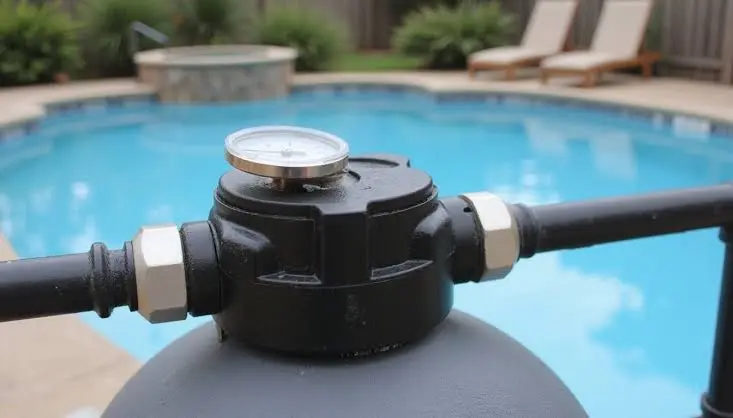
Your pool filter pressure gauge is one of the most useful diagnostic tools on your entire equipment pad. It tells you whether water is moving through the system the way it should, or whether something is restricting flow, leaking air, or slowly failing. The problem is, most pool owners never learn how to read it properly.
This guide explains what your PSI reading actually means, what causes it to climb too high or drop too low, how to troubleshoot the most common pressure problems, and when the reading on your gauge is telling you to call a professional.
What Does Pool Filter PSI Actually Mean?
PSI stands for pounds per square inch. The pressure gauge mounted on top of your pool filter measures how much resistance exists inside the filter tank as the pump pushes water through it.
Think of it this way. Your pool pump pulls water from the pool through the skimmer and main drain, then pushes that water through the filter and back into the pool through the return lines. The gauge reads the pressure at the point between the pump’s output and the filter media inside the tank.
When water flows freely through clean filter media, the pressure stays relatively low. As the media collects debris, dirt, oils, and organic material over time, it becomes harder for water to pass through. That restriction causes the pressure to rise. When something blocks water from reaching the pump in the first place, the pressure drops.
That relationship between water flow and gauge reading is what makes the pressure gauge so valuable. A rising number tells you something is creating resistance after the pump. A falling number tells you something is restricting flow before the pump. Those two directions point you toward completely different parts of your pool system.
What Should My Pool Filter Pressure Be?
There is no single correct PSI that applies to every pool. A reading of 12 PSI might be perfectly normal on one system and a sign of trouble on another.
Normal operating pressure depends on several factors that are unique to your pool:
Your pump size and type, your filter size and media type, the diameter of your plumbing, the total length of your pipe runs, how many skimmers and returns you have, and whether additional equipment like heaters or salt chlorine generators add resistance to the system.
Most residential pool filters operate somewhere between 10 and 25 PSI when the system is running normally. Variable speed pumps running on lower speeds can produce readings as low as 3 to 5 PSI, which is completely fine for those settings.
The number that actually matters is your clean filter baseline. This is the pressure reading your gauge shows right after you have cleaned, backwashed, or replaced your filter media and the system is running at its normal operating speed.
Whatever that number is on your pool, write it down. Mark it directly on the filter tank with a permanent marker or note it in your phone. Every pressure reading you take from that point forward should be compared against that baseline. A reading of 18 PSI means nothing on its own. A reading of 18 PSI when your clean baseline is 10 PSI means your filter needs attention.
Here is the rule most pool professionals follow: when your filter pressure rises 8 to 10 PSI above your clean baseline, it is time to clean or backwash the filter.
If you have recently replaced your pump, changed your filter media, added a heater, or made any significant modification to your plumbing, you will need to re-establish your baseline because the old number no longer applies.
Is 20 PSI Too High for a Pool Filter?
It depends entirely on your system. For a pool with a clean baseline of 10 PSI, a reading of 20 PSI means the filter is loaded with debris and needs cleaning. For a pool with a clean baseline of 16 PSI, a reading of 20 PSI is only 4 PSI above baseline and still within a normal operating range.
Context matters more than the number itself. That said, any reading approaching 25 to 30 PSI on most residential systems deserves attention, and anything above 30 PSI should be treated as a potential safety concern. Most pool filters and equipment are rated for a maximum of 50 PSI, with the range between 30 and 50 serving as a safety margin you should never intentionally operate within.
Why Understanding Suction Side vs. Pressure Side Matters
This concept is one of the most important things to understand about pool filter pressure, and many online guides either skip it or bury it at the bottom of the page.
Your pool pump sits at the center of the circulation system. Everything before the pump (the skimmers, main drains, suction plumbing, pump strainer basket, and pump lid) is called the suction side. Everything after the pump (the filter, heater, salt cell, return plumbing, and return jets) is called the pressure side.
Low pressure almost always points to a problem on the suction side. If the pump is not pulling enough water from the pool, there is not enough volume entering the filter to build normal pressure. The restriction is somewhere before the pump.
High pressure almost always points to a problem on the pressure side or inside the filter. If water is being pushed into the filter but something is restricting it from flowing out and back to the pool, pressure builds inside the tank. The restriction is somewhere after the pump.
Keeping that distinction in mind will save you from chasing the wrong problem. When your gauge reads high, look at the filter media and the return plumbing. When it reads low, look at the skimmers, baskets, suction plumbing, and the pump itself.
High Pool Filter Pressure: Causes and What to Check
When your gauge reads significantly above your clean baseline, work through these causes in order. Start with the simplest and most common issues first.
Dirty or Clogged Filter Media
This is the most frequent reason for high filter pressure and the easiest to rule out. As your filter catches debris, oils, and fine particles during normal operation, the media becomes increasingly restrictive. That is exactly what it is supposed to do. But once the buildup passes a certain point, the pressure climbs high enough that the filter is no longer moving water efficiently.
For sand filters, backwash the filter until the sight glass or waste water runs clear, then rinse for 30 seconds before returning to the filter setting.
For cartridge filters, remove the cartridge element and rinse it thoroughly with a garden hose, working through each pleat to flush out trapped debris. If a standard rinse does not bring the pressure back down, a chemical soak with a filter cleaning solution can remove oils and scale that water alone cannot reach.
For DE filters (diatomaceous earth), backwash the filter, then recharge with the correct amount of DE powder as specified by the manufacturer. If pressure remains high after backwashing, you may need to break down the filter and clean the grids by hand.
If your pressure returns to baseline after cleaning, the problem was simply a dirty filter. If it does not, keep reading.
Filter Media That Needs Replacement
Filter media does not last forever, and there comes a point where cleaning no longer restores normal flow.
Sand filter media typically lasts 5 to 7 years before the sand grains become worn, rounded, and coated with oils that chemical cleaning cannot remove. At that point, the sand channels (water finds paths of least resistance rather than flowing evenly through the sand bed), filtration quality drops, and pressure stays elevated.
Cartridge filter elements generally last 1 to 3 years depending on pool usage and water chemistry. Over time, the pleated fabric compresses, the fibers degrade, and the effective surface area shrinks. If rinsing and chemical soaking no longer bring the pressure back to baseline, the cartridge needs replacing.
DE filter grids can tear or develop holes, allowing DE powder to coat unevenly and create patchy areas of high resistance. If your pressure stays high after a backwash and fresh DE recharge, inspect the grids for tears, cracks, or deteriorated fabric.
Closed or Partially Closed Return Valves
This one gets missed more often than you might expect. If a valve on the return side of the system (the plumbing that carries filtered water back to the pool) is partially or fully closed, it creates a restriction that forces pressure upward.
Check every valve between the filter and the pool return jets. Make sure they are all fully open. This problem sometimes occurs after maintenance or equipment work when valves are temporarily closed and not fully reopened.
Blocked Return Lines or Equipment
Anything that restricts water flow after the filter will cause pressure to build. This includes a clogged pool heater, a scaled or dirty salt chlorine generator cell, or debris lodged in the return plumbing.
If your pool system includes a heater, check whether the heater bypass is properly set. A partially open bypass combined with a partially restricted heater can create enough backpressure to push the gauge upward.
Air Trapped in the Filter Tank
Air that accumulates at the top of the filter tank can push the pressure reading up artificially. Most pool filters have a manual air relief valve (sometimes called a bleeder valve) on top of the tank near the pressure gauge.
To release trapped air, start the pump and let it reach full speed, then slowly open the air relief valve. You will hear air hissing out first. Once a steady stream of water begins flowing from the valve, close it. If you find that air keeps building up between filter cleanings, there may be a suction side air leak that needs to be addressed separately.
Broken Internal Components
Multiport valves on sand and DE filters have internal gaskets and diverter assemblies that can wear out or crack over time. If a piece breaks loose inside the valve, it can lodge in a pipe fitting or internal passage and create a sudden, severe restriction.
Similarly, sand filter laterals (the finger shaped distribution tubes at the bottom of the tank) can crack with age. A broken lateral can allow sand to migrate into the plumbing while also creating uneven flow distribution that raises pressure.
Faulty Pressure Gauge
If you have cleaned your filter, checked all your valves, and confirmed that water is flowing back to the pool normally but the gauge still reads high, the gauge itself may be the problem. Pool pressure gauges take a beating from UV exposure, chemical fumes, vibration, and moisture. A stuck needle, a fogged dial, or corroded internal components can all produce false readings.
Replace it. Pressure gauges are inexpensive and take just a few minutes to swap out. Use Teflon tape on the threads for a clean seal.
Low Pool Filter Pressure: Causes and What to Check
When the gauge reads well below your clean baseline, the issue is almost certainly on the suction side of the system. The pump is not getting enough water to build normal operating pressure.
Low Pool Water Level
This is the simplest cause and the first thing to check. If the water level drops below the middle of the skimmer opening, the skimmer begins gulping air along with water. That air reduces the pump’s ability to create suction, and pressure drops.
Top the pool up to the proper level (midway up the skimmer opening) and monitor the gauge.
In Charleston and the Lowcountry, pool water levels can drop faster than expected during the hotter months due to evaporation, splash out, and heavy summer use. Checking your water level weekly is a good habit year round.
Clogged Skimmer Basket
The skimmer basket is your first line of defense against debris. Leaves, pine needles, bugs, and organic material collect in the basket and gradually restrict water flow to the pump. A packed skimmer basket starves the pump of water, and pressure falls.
Turn off the pump, remove the basket, clear the debris, and check the flow again.
Clogged Pump Strainer Basket
If the skimmer basket is clear but pressure is still low, check the pump strainer basket. Smaller debris, hair, fine leaves, and organic material that passes through the skimmer can accumulate in the pump basket and restrict flow further.
Turn off the pump, remove the pump lid (be careful, the lid may be under slight vacuum), and clean the basket thoroughly.
Blocked or Restricted Suction Lines
If both baskets are clean but pressure remains low, the blockage may be deeper in the suction plumbing. Debris can build up in the underground piping between the skimmer and the pump, especially in older pools or systems surrounded by heavy tree cover.
Clearing a suction line blockage often requires professional equipment such as a drain king (a bladder type hose attachment) or a plumber’s snake designed for pool lines. If you suspect a blocked suction line, this is a good point to contact a professional for diagnosis.
Suction Side Air Leak
Air leaks on the suction side are one of the most common and most frustrating causes of low filter pressure. Any point where air can enter the system between the pool water surface and the pump impeller will reduce the pump’s ability to move water efficiently.
The most common air leak locations include the pump lid o-ring, union fittings on the suction plumbing, threaded connections on valves, the pump drain plugs, and cracked fittings.
Signs that air is entering the system include visible air bubbles in the pump strainer basket while the pump is running, air bubbles blowing from the return jets into the pool, a gurgling or surging sound from the pump, and the pump periodically losing prime.
Locating suction side air leaks can be tricky. Sometimes the leak is obvious (a cracked pump lid, a dried out o-ring). Other times it requires methodical testing of each connection point. If you are seeing air bubbles in your pool or your pump is repeatedly losing prime, that is a strong indicator of a suction side issue that may need professional leak detection.
Pump Losing Prime
If the pump cannot maintain a full column of water from the pool to the impeller, it cannot generate normal pressure. A pump that keeps losing prime is telling you there is an air intrusion or a flow restriction somewhere on the suction side.
Common causes include all the issues listed above (low water, clogged baskets, air leaks), but also include a worn pump lid o-ring, a crack in the pump housing, or a failing shaft seal.
A pump that repeatedly loses prime should not be ignored. Running a pump without water, even briefly, generates extreme heat and can damage the mechanical shaft seal, the impeller, and the motor. If your pump keeps losing prime after you have checked all the basics, it is time for a professional inspection.
Pump Impeller Blockage
The impeller is the spinning component inside the pump that actually moves the water. Small debris, hair, string, and organic matter can wrap around the impeller hub or lodge between the impeller vanes, reducing the pump’s ability to generate flow and pressure.
Clearing an impeller usually requires removing the pump housing or accessing the impeller through the volute. If you are not comfortable working on the pump internals, this is a repair best left to an experienced technician.
Weak or Failing Pump
If none of the above issues explain the low pressure, the pump itself may be aging or failing. A pump motor that is losing power, bearings that are wearing out, or an impeller that has corroded or eroded will all produce lower flow rates and reduced system pressure over time.
Signs of a failing pump include unusual motor noise (grinding, humming, screeching), the motor running hot to the touch, the pump tripping the circuit breaker, or a gradual decline in system performance that cleaning and basic troubleshooting cannot resolve.
Pump diagnosis and replacement is something you want done correctly. A pump that is improperly sized, installed, or plumbed can create new problems that are worse than the one it replaced. The Pool Care Pros can inspect your equipment and help determine whether a repair or replacement makes the most sense.
Damaged or Faulty Pressure Gauge
Just as a faulty gauge can read falsely high, it can also read falsely low or stick at zero. If the return jets in your pool are flowing strongly but the gauge reads near zero, suspect the gauge before anything else. Replace it and see if the new gauge gives you a reading that matches the actual flow you can observe.
How Pressure Behaves Differently by Filter Type
Not all pool filters respond to problems in the same way. Understanding your specific filter type helps you interpret what the pressure gauge is telling you.
Cartridge Filters
Cartridge filters tend to show a more gradual pressure increase over time as the pleated element collects debris. Pressure typically rises slowly and steadily between cleanings. If pressure spikes suddenly on a cartridge filter, it usually means something unusual entered the system (a heavy debris load, algae, or fine particles from a water chemistry issue).
Cartridge filters cannot be backwashed. The only way to reduce pressure is to remove the cartridge and rinse or soak it. Because of this, cartridge filters are more sensitive to oil buildup from sunscreen, lotions, and body oils. Over time, those oils coat the fabric and reduce flow even after rinsing. A periodic chemical soak with a cartridge cleaning solution helps extend the life of the element.
Sand Filters
Sand filters require regular backwashing to maintain normal pressure. After a backwash, pressure should drop back close to your clean baseline. If it does not, the sand may be channeled, oil saturated, or simply old enough that it needs replacing.
One thing unique to sand filters: pressure can sometimes rise within 24 to 48 hours of a backwash during an active algae bloom. The algae overwhelms the filter faster than normal debris would. If this is happening, the underlying algae problem needs to be treated chemically before the filter will behave normally.
DE Filters
DE filters offer the finest level of filtration and tend to produce the best water clarity, but they are also more maintenance intensive. Pressure on a DE filter can rise quickly if the grids are not evenly coated with DE powder, if the grids are torn, or if the system is run continuously without rest periods that allow the DE cake to relax slightly.
After backwashing a DE filter, you must add the correct amount of fresh DE powder through the skimmer. Too much DE creates unnecessary restriction. Too little allows debris to reach the grids and reduces filtration quality. Check your filter’s manual for the exact measurement.
Pressure Gauge Troubleshooting
The gauge itself is a small, inexpensive component that lives in one of the harshest environments on your equipment pad. Sun, rain, chemical fumes, and constant vibration take their toll. Here is how to tell whether your gauge is giving you accurate information.
The gauge reads zero when the pump is running. Either the gauge has failed, or no water is reaching the filter at all. Check whether water is flowing from the return jets. If the jets are flowing normally, the gauge is dead and needs replacing. If no water is flowing, you have a flow problem to diagnose.
PSI suddenly spikes. A rapid, dramatic increase in pressure usually means something has changed in the system suddenly. A valve may have been closed, a large amount of debris may have entered the filter at once, or an internal component may have broken loose and created a blockage. Do not ignore a sudden spike. If pressure climbs rapidly and you cannot identify the cause, shut the pump off and investigate.
PSI slowly increases over days or weeks. This is normal filter loading. The filter is doing its job, collecting debris, and gradually building resistance. When the pressure reaches 8 to 10 PSI above your clean baseline, clean the filter.
Pressure fluctuates erratically. If the needle bounces around without settling, air may be intermittently entering the system. A suction side air leak that comes and goes (for example, a marginal o-ring seal that only leaks under certain conditions) can cause pressure to swing. A failing gauge can also produce erratic readings.
When to replace the gauge. Replace your pressure gauge if the needle does not return to zero when the pump is off, if the dial is foggy or water filled, if the needle appears bent or stuck, if readings seem inconsistent with what you can observe at the return jets, or if the gauge is more than a few years old and has been exposed to the elements. A new gauge is one of the cheapest and most useful investments you can make in your pool equipment.
When to Clean or Backwash Your Filter
The general rule is simple: clean your filter when the pressure rises 8 to 10 PSI above your clean baseline. Do not wait until the pressure reaches extreme levels, because running at high pressure for extended periods puts unnecessary stress on your pump motor, o-rings, fittings, and the filter tank itself.
Here is a practical approach:
After cleaning or backwashing, note your baseline pressure. Check the gauge at least once a week as part of your regular pool maintenance. When the reading reaches 8 to 10 PSI above baseline, it is time to clean the filter again.
Some pools in high use situations, pools surrounded by heavy landscaping, or pools dealing with water chemistry issues may need more frequent cleaning. If you find yourself cleaning the filter every few days and the pressure keeps coming back quickly, that is not a filter problem. Something else is going on, whether it is an algae bloom, a water chemistry imbalance, or deteriorating filter media that can no longer do its job properly.
Can High Pool Filter Pressure Damage Equipment?
Yes. Sustained high pressure does real damage over time.
The pump motor works harder against elevated backpressure, generating more heat and accelerating wear on the motor windings, bearings, and seals. O-rings and gaskets throughout the system degrade faster under continuous pressure. The filter tank itself is under stress, and while modern filter tanks are built with safety margins, operating well above the recommended range over extended periods increases the risk of cracks, leaks, or in extreme cases, a catastrophic tank failure.
Filter tanks that use a clamshell design with a center clamp band (common on many cartridge and DE filters) are particularly important to monitor. If the clamp band is leaking water, it is not making a secure seal, and that creates additional risk under high pressure.
Never operate a pool system above 30 PSI if you can avoid it. And always keep your hand near the power switch and your eye on the pressure gauge when starting the pump, especially after maintenance or equipment work.
Safe Homeowner Checks vs. Professional Diagnosis
There are several things you can safely check and address on your own as a pool owner:
Checking and topping up the pool water level. Cleaning the skimmer basket and pump strainer basket. Inspecting and lubricating the pump lid o-ring. Backwashing a sand or DE filter. Rinsing a cartridge filter element. Bleeding air from the filter tank using the air relief valve. Checking that all return side valves are fully open. Replacing a pressure gauge. Noting and tracking your clean baseline pressure.
These are routine maintenance tasks that every pool owner should be comfortable with.
However, there are situations where you should stop troubleshooting and call a professional:
Pressure is dangerously high (above 25 to 30 PSI) and you cannot identify the cause. Do not continue running the pump.
Equipment is leaking. Water leaking from the pump, filter, or plumbing under pressure can indicate cracked housings, failed seals, or damaged fittings that need proper repair.
The pump repeatedly loses prime after you have checked the water level, baskets, and pump lid o-ring. Persistent prime loss usually points to a suction side air leak or a plumbing issue that requires professional leak detection.
Water circulation is poor despite normal pressure readings. This can indicate internal valve problems, plumbing restrictions, or equipment that is not performing to specification.
Return valves or underground plumbing may be blocked. Clearing plumbing blockages and diagnosing valve problems often requires specialized tools and experience.
The filter housing appears cracked, warped, or damaged. A compromised filter tank under pressure is a safety hazard. Do not attempt to operate or repair it yourself.
PSI remains abnormal after you have cleaned the filter, checked all valves, and confirmed the gauge is working. When basic troubleshooting does not resolve the pressure problem, the cause is likely deeper in the system and needs a trained eye.
The pump motor is making unusual noises, running hot, or tripping the breaker. Electrical and mechanical pump problems should be diagnosed by someone experienced with pool equipment.
Pool filter systems operate under pressure. The water inside the tank, the air above it, and the forces involved when opening filter housings or disconnecting plumbing are all real hazards. Never open a filter tank or disconnect plumbing while the system is under pressure. Always shut off the pump and open the air relief valve to depressurize the system before performing any hands on maintenance.
Why Does Filter PSI Rise Immediately After Cleaning?
If you clean or backwash your filter and the pressure does not drop back to baseline, or it rises back to high levels within hours, that tells you the filter media itself may be the problem.
With cartridge filters, this often means the fabric is saturated with oils and minerals that water rinsing alone cannot remove. Try a chemical cleaning soak. If that does not restore baseline pressure, the cartridge has reached the end of its useful life and needs to be replaced.
With sand filters, it can mean the sand is old, channeled, or oil saturated. A sand filter cleaner product can sometimes help, but if the sand is more than 5 to 7 years old and pressure will not come down, replacing the sand is the most reliable fix.
With DE filters, rapid pressure return after backwashing can indicate torn grids, an incorrect DE charge, or an underlying water clarity problem (like algae) that is overloading the filter faster than it can handle.
If pressure keeps rising within 24 to 48 hours of every cleaning and you have ruled out the filter media, consider whether you are dealing with an active water quality issue. Algae, fine suspended particles, or high bather loads can all clog filters at an accelerated rate.
Pool Filter Pressure and Charleston’s Pool Season
Here in the Charleston area, pool season runs longer than in many parts of the country. The combination of high temperatures, high humidity, extended swim seasons, and heavy organic debris from surrounding trees and landscaping means pool filters work harder and need attention more frequently than in cooler, drier climates.
Oak pollen in the spring, live oak leaves that drop nearly year round, and afternoon summer thunderstorms that wash debris into the pool all contribute to faster filter loading. If you notice your filter pressure climbing faster than usual during peak season, more frequent cleaning may be all that is needed. But if the pattern continues even after fresh media or a thorough cleaning, it is worth having your entire circulation system evaluated.
The Lowcountry’s sandy soils and high water tables can also contribute to unique plumbing challenges. Shifting ground, root intrusion, and soil conditions can stress underground pool plumbing over time, sometimes leading to leaks that affect circulation and pressure.
When Your Pressure Gauge Is Telling You to Call a Pro
Your pool filter pressure gauge is not just a maintenance reminder. It is a diagnostic instrument. Every reading, whether high, low, stable, or erratic, is giving you information about what is happening inside your circulation system.
Most of the time, the message is simple: the filter needs cleaning. But when the basics do not resolve the problem, when pressure stays stubbornly high after a thorough cleaning, when it drops and will not come back up, when the pump keeps losing prime, or when you are seeing signs of equipment wear, the gauge is telling you something deeper is going on.
That is when it makes sense to bring in someone who can look at the full picture. Pressure problems that persist beyond routine maintenance often involve plumbing restrictions, equipment wear, valve failures, or air leaks that are difficult to find without experience and the right diagnostic tools.
If your pool filter pressure is not behaving the way it should and basic troubleshooting has not fixed it, The Pool Care Pros can help. Our team diagnoses and repairs pool equipment, circulation problems, and plumbing issues across Charleston, Mount Pleasant, Summerville, West Ashley, James Island, Goose Creek, Daniel Island, and the surrounding Lowcountry.
Request a quote or call us at 843-345-2415 to schedule an equipment inspection. We will find out what your pressure gauge is really trying to tell you.


